
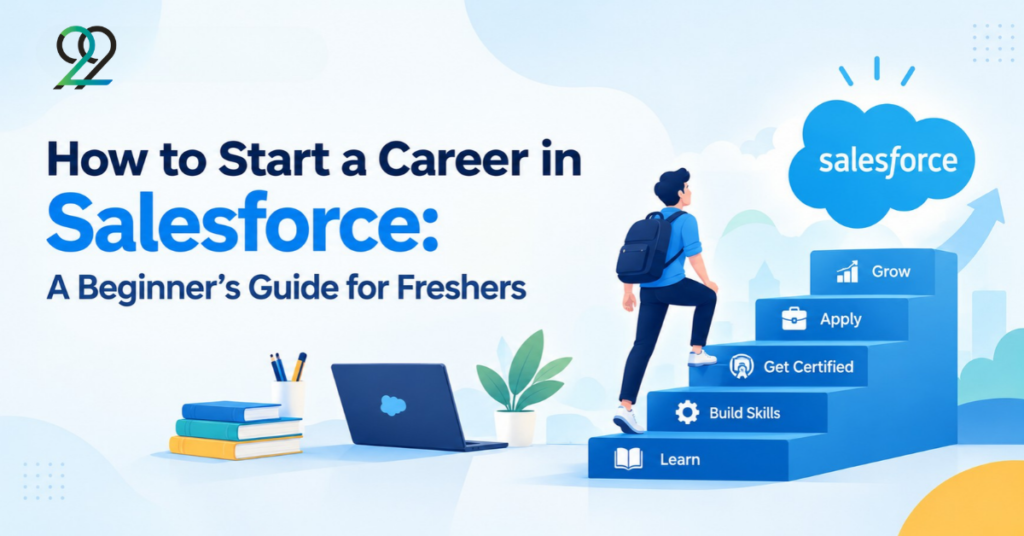
Starting a career in technology can feel confusing when you do not know which skill to learn first. There are programming languages, cloud platforms, AI tools, databases, and countless courses to choose from. If you are a fresher looking for a career path with a combination of technology and business applications, Salesforce can be a field worth exploring.
Salesforce is a major CRM platform used by organizations to manage customer information, sales, service, marketing, and business processes. But learning Salesforce is not simply about memorizing features. To become job-ready, students need to understand how the platform works and how it is used to solve real business problems.
What Does a Salesforce Professional Do?
A Salesforce professional can work in several different roles.
A Salesforce Administrator generally works with configuration, users, data, reports, dashboards, automation, and platform management.
A Salesforce Developer works more deeply with customization and development, including Apex, Lightning components, integrations, and other technical solutions.
There are also roles such as Salesforce Consultant, Business Analyst, Data Analyst, and Architect.
Salesforce itself currently presents multiple career paths, including Administrator, Developer, Consultant, and Architect.
This means you do not have to decide your entire career on the first day. You can start with the fundamentals and gradually understand which role matches your interests.
Can Freshers Learn Salesforce?
Yes. You do not necessarily need previous Salesforce work experience to start learning the platform.
The important thing is to build your knowledge in the right order.
If you are completely new, begin with basic concepts:
- What is CRM?
- What is Salesforce?
- What are objects and records?
- What are fields?
- How does Salesforce store information?
- What is automation?
- What are reports and dashboards?
Once these concepts become comfortable, you can move toward development or administration based on your career goal.
Salesforce’s own beginner learning paths cover areas such as data modeling, data management, Lightning customization, reports, and dashboards.
Should You Learn Coding First?
This is one of the most common questions from students.
The answer depends on the role you want.
If your goal is to become a Salesforce Developer, learning programming concepts is important. You may eventually work with Apex, SOQL, Lightning, JavaScript, APIs, and integrations.
However, you do not need to know everything before starting Salesforce.
Begin with basic programming logic. Understand variables, conditions, loops, methods, and object-oriented concepts. Then gradually connect those concepts to Salesforce development.
If you are more interested in configuration, business processes, and platform management, you may explore the Salesforce Administrator path first.
The key is to choose a direction instead of trying to learn every Salesforce technology simultaneously.
Learn by Building Projects
One of the biggest mistakes beginners make is spending months watching videos and taking notes without actually building anything.
Hands-on projects can make learning much more practical.
For example, you could build a simple Salesforce application for a fictional company. Create customers, products, cases, or opportunities. Add fields and relationships. Create automation for common tasks. Build reports and dashboards.
Later, you can add more advanced features such as Apex, integrations, or Lightning components.
Projects also give you something useful to discuss during interviews.
Instead of saying:
“I learned Salesforce Development.”
you can explain:
“I created a Salesforce application, designed the data model, built automation, developed custom functionality, and tested the solution.”
That gives an interviewer a much clearer idea of what you actually know.
Do You Need a Salesforce Certification?
A certification can be useful, but it should not be your only goal.
Certifications can help demonstrate knowledge of a particular Salesforce role or product. Salesforce provides credentials across areas such as administration, development, architecture, consulting, data, and other roles.
For a beginner, however, certification preparation should ideally happen alongside practical learning.
Think of it this way:
Certification shows what you have studied.
Projects show what you can do.
Having both can create a stronger profile.
Build a Resume Around Skills and Projects
Freshers often struggle with their resumes because they do not have professional experience.
You can still create a useful resume by highlighting your learning journey.
Include:
- Salesforce skills you have learned
- Technical skills
- Academic or personal projects
- Salesforce certifications, if completed
- Training and practical assignments
- Relevant internships
- GitHub or portfolio work, where applicable
Do not simply create a long list of Salesforce keywords. Be ready to explain every technology mentioned on your resume.
Prepare for Salesforce Interviews
Learning the technology is only one part of becoming job-ready.
You also need to prepare for interviews.
Start with basic Salesforce questions and gradually move toward scenario-based questions.
For developer roles, expect questions around topics such as Apex, SOQL, triggers, governor limits, Lightning, integrations, and security.
But technical knowledge alone is not enough. Interviewers may also ask you to explain your project, describe a problem you faced, or explain why you selected a particular solution.
Practice explaining technical concepts in simple language.
Salesforce’s own career learning resources also include resume preparation, interview strategies, communication, and career planning alongside technical learning.
Why Live and Project-Based Training Can Help
For a beginner, having someone available to explain difficult concepts can make the learning process easier.
A live learning environment allows students to ask questions when they get stuck instead of moving ahead with an unclear concept. Project-based learning also helps connect classroom concepts with actual implementation.
9to9Academy’s Freshers Program is designed for candidates without prior Salesforce experience and combines foundation-to-advanced learning with hands-on projects, resume support, mock interviews, and placement assistance.
This kind of approach can help students focus not only on completing a course but also on becoming more prepared for the hiring process.
A Simple Salesforce Career Roadmap
If you are starting from zero, do not make your learning plan unnecessarily complicated.
Follow a simple progression:
Step 1: Understand Salesforce and CRM basics.
Step 2: Learn the Salesforce platform and data model.
Step 3: Choose your career direction.
Step 4: Learn the technical skills required for that role.
Step 5: Build practical Salesforce projects.
Step 6: Work on your resume and professional profile.
Step 7: Practice Salesforce interview questions.
Step 8: Consider the relevant certification.
Step 9: Apply for suitable entry-level opportunities.
Final Thoughts
Starting a Salesforce career as a fresher does not require you to know everything from the beginning. What matters more is having a clear learning path and consistently practicing what you learn.
Focus on fundamentals first. Build projects instead of relying only on theory. Understand your chosen role, prepare for interviews, and gradually add certifications and advanced skills.
With the right combination of Salesforce knowledge, practical experience, communication skills, and interview preparation, you can move from being a beginner to becoming a more confident candidate for Salesforce opportunities.